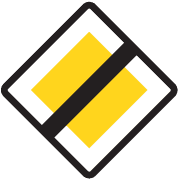
B 11 — Unconditional duty to give way
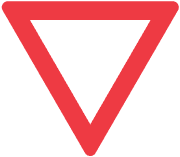
B 11 Unconditional duty to give way is a sign indicating that road users driving onto or across a road have an unconditional duty to give way to the moving traffic from both sides. This means that you must stop and give way to the traffic on the road, no matter which direction it comes from.
The sign is normally used together with S 11 Give-way line, a road marking that indicates the physical boundary where road users must stop and give way at junctions or entrances.
To give advance warning of the unconditional duty to give way and inform road users about it, the sign can be combined with the supplementary panels U 1 and UB 11,1. The supplementary panel U 1 is used to give advance warning of the B 11 sign, while the supplementary panel UB 11,1 is used to give advance warning of the B 13 sign.
D 12 Mandatory direction of travel in a roundabout may also be placed below the B 11 sign, indicating the direction in which vehicles must travel in a roundabout.
It is important to pay attention to the B 11 Unconditional duty to give way sign and to observe the rules it sets out, so that traffic flows safely and smoothly. Respecting the duty to give way is essential in order to avoid accidents and create a safe experience in traffic for all road users.
B 13 — Stop
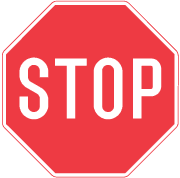
The B 13 Stop sign indicates that drivers have an unconditional duty to give way and must stop before entering a junction or before crossing railway tracks. This means that road users must come to a complete stop at the stop line and give way to the moving traffic on the road or at the railway track.
At junctions, however, cyclists and riders of small mopeds who lawfully use the cycle path may turn right along the cycle path on the right-hand side of the crossing road without stopping, if this can be done without inconvenience to other road users.
At railway tracks, the B 13 Stop sign is placed below A 74 Crossing marker, which indicates that there is a crossing with railway tracks.
The sign is normally used together with S 13 Stop line, a road marking that indicates the physical stop line where road users must stop at junctions or entrances.
It is important to observe the B 13 Stop sign and to stop completely at the stop line, so that traffic flows safely and accidents are avoided. Respecting the duty to give way and handling stop situations correctly are essential to road safety.
B 15 — Merging
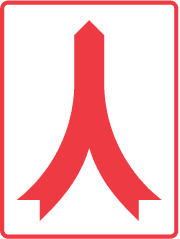
The B 15 Merging sign indicates that carriageways run together and that road users must ease the merging of the traffic streams by showing mutual consideration. The sign is used mainly where motorway carriageways run together and at acceleration lanes.
When traffic streams have to merge, the drivers of vehicles on both carriageways must adjust their driving to create a smooth and safe flow of traffic. This requires road users to show consideration and make room for one another, so that the merge can happen smoothly and without unnecessary obstruction or danger.
The B 15 Merging sign is used as a reminder to road users to pay attention, show consideration and ease the merging of the traffic streams. It is important that the drivers on both carriageways are aware of each other, adjust their speed and find suitable gaps in order to fit into the merged traffic.
At merges on motorway carriageways and acceleration lanes it is particularly important to pay attention and show consideration, because differences in speed and different streams of vehicles can occur. By following the B 15 sign and showing consideration, road users can contribute to a smooth and safe flow of traffic at merges.
B 16 — Main road
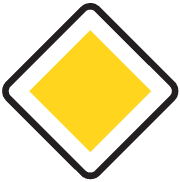
The B 16 Main road sign indicates that traffic from side roads has an unconditional duty to give way to the traffic on the main road, unless signs such as B 11, B 13 or B 15 have been placed on the main road. At the same time, the sign indicates that parking on the carriageway is prohibited outside built-up areas, in accordance with section 29(3)(iii) of the Danish Road Traffic Act.
When drivers of vehicles approach a main road, they must be aware that they have a duty to give way and must stop for the traffic on the main road. This gives the traffic on the main road priority and ensures a smooth and safe flow of traffic. An unconditional duty to give way from side roads to main roads helps to reduce the risk of collisions and to create an even flow of traffic on the main road.
In addition, the B 16 Main road sign also indicates that parking on the carriageway is prohibited outside built-up areas. This means that vehicles may not park directly on the carriageway of a main road. Using the supplementary panel UC 60,6 Parking on the verge prohibited, it can also be indicated that parking on the verge (the footway) along the main road is prohibited as well.
The B 16 Main road sign makes sure that road users are aware of the duty to give way from side roads and comply with the parking rules, so that traffic on main roads flows safely and efficiently.
B 17 — End of main road
The B 17 End of main road sign indicates that the stretch of road on which the main-road rules and priority applied now ends. The sign marks that you are leaving the area with main-road status and entering a different category of road, where the rules may be different.
When you pass the B 17 End of main road sign, you must be aware of changes in the traffic conditions and of any changes in priority, speed limits or other traffic rules. It may be necessary to adapt your driving behaviour and your duty to give way to the new rules for the road in question.
The sign is important in order to inform road users that they are now leaving a main road and entering a different category of road. It is important to pay attention and to follow the rules that apply on the new stretch of road, so that traffic flows safely and smoothly.
B 18 — Give way to oncoming traffic
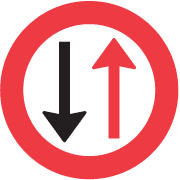
The B 18 Give way to oncoming traffic sign indicates that road users may only drive onto the stretch of road when they can pass along it without forcing oncoming vehicles to stop. The sign is typically used on narrow roads, or on roads where there is limited room to pass oncoming traffic.
Where the B 18 sign has been put up, road users must take particular care and pay attention to oncoming vehicles. You should only drive onto the stretch of road when there is enough room for both your own vehicle and oncoming vehicles to pass without having to stop or being obstructed.
The purpose of the sign is to ensure a smooth and safe flow of traffic on roads where there is no room for two vehicles side by side. It is important to observe the sign and to show consideration for oncoming traffic in order to avoid dangerous situations and possible collisions.
You are always advised to follow the signage and the traffic rules that apply in the situation in question, so that your driving is safe and responsible.
B 19 — Oncoming traffic must give way
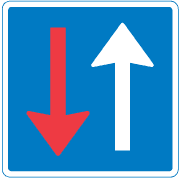
The B 19 Oncoming traffic must give way sign indicates that oncoming traffic must hold back and give way to drivers on the stretch of road where the sign has been put up. The sign is typically used in situations where traffic needs to be kept flowing in one direction and collisions between oncoming vehicles have to be avoided.
Where the B 19 sign has been put up, drivers on that stretch of road have priority, and oncoming traffic must hold back and let them pass. It is important that oncoming road users show consideration and observe the signage in order to avoid dangerous situations and create a safe flow of traffic.
The sign may be put up on narrow roads, on roads with limited visibility, or on roads where the traffic stream needs to be guided in a particular direction. The purpose is to ensure an orderly, one-way-at-a-time flow of traffic and to reduce the risk of collisions between oncoming vehicles.
It is important to follow the signage and the traffic rules that apply in the situation in question, so that your driving is safe and responsible.